Life Cycle and Cost Assessment of a Water Quality Trading Approach for Nutrient Permit Compliance
Project Brief
The Challenge
Under the National Pollutant Discharge Elimination System (NPDES), effluent nutrient limits are applied to wastewater treatment facilities (WWTFs) to protect downstream waterbodies from nutrient pollution, but they can be difficult for smaller facilities to achieve due to funding constraints. The U.S. Environmental Protection Agency’s (EPA’s) National Water Quality Trading (WQT) Policy encourages market-based approaches to improving water quality and maximizing ancillary benefits beyond the primary purpose of water quality permit compliance; however, WQT adoption has been slow. Critics of WQT argue that the approach simply trades one pollution source for another, with little net improvement to the surrounding environment. Also, little information exists about the full potential benefits—monetary and non-monetary—of WQT as a nutrient permit compliance option.
ERG's Solution
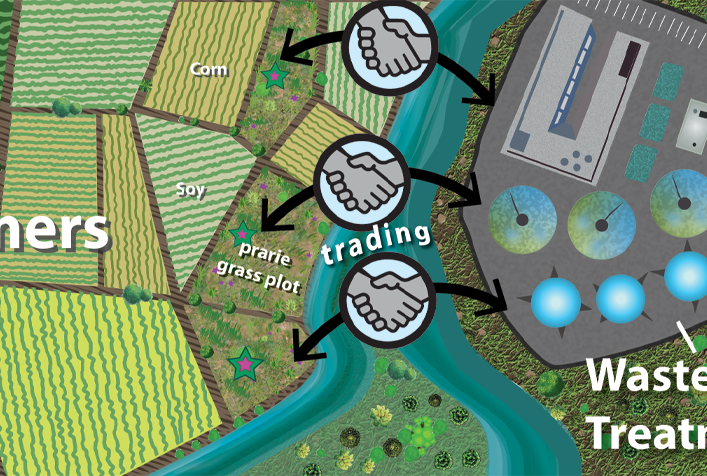
To comprehensively evaluate its costs and benefits, ERG supported EPA’s Office of Research and Development in performing a life cycle assessment (LCA) and life cycle cost assessment (LCCA) of a WQT approach to nutrient permit compliance for nine small rural wastewater treatment facilities (WWTFs) in Wisconsin’s Kickapoo watershed that were not meeting their effluent nutrient standards. For each facility, we compared existing conditions to scenarios where permit requirements were addressed through conventional technological upgrades or through WQT. WQT scenarios consisted of modeling the conversion of corn and soybean cropland to perennial grassland to generate sufficient nutrient trading credits for each WWTF. Modeling of changes to nutrient emissions from converted croplands was performed using Wisconsin’s WQT program SnapPlus and Texas A&M’s Soil and Water Assessment Tool (SWAT). The LCA and LCCA results demonstrated that the WQT approach was generally more cost-effective than the technological approach; reduced life cycle nutrient emissions beyond what was required by permit compliance; and resulted in greater climate benefits through reduced greenhouse gas emissions and greater potential for long-term soil carbon sequestration. ERG coauthored an article in “Water Research X” that describes this work.
Client
U.S. Environmental Protection Agency