Support for EPA’s Fourth NATTS Network Assessment
Project Brief
The Challenge
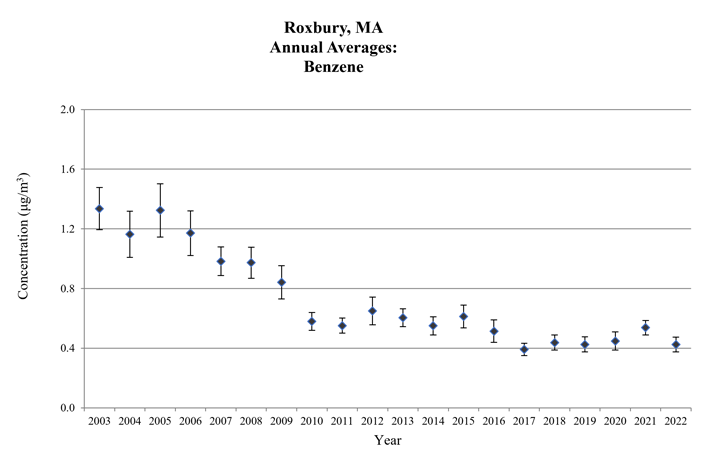
Starting in 2003, the U.S. Environmental Protection Agency (EPA) created the National Air Toxics Trends Station (NATTS) Network to monitor the concentration of hazardous air pollutants over time so that EPA could track trends in air toxic concentrations and evaluate the effectiveness of efforts to reduce air toxics across the nation. Under the agency’s National Ambient Air Monitoring Strategy, EPA is required to evaluate and modify the NATTS Network every six years. EPA contracted with ERG to support the Fourth NATTS Network Assessment, which covers years 2003 to 2022.
ERG's Solution
ERG supported all aspects of this assessment, including both the quantitative and qualitative components. Our work included developing databases, quality assuring and controlling the data, conducting stakeholder interviews, and analyzing the data.
- For the quantitative component, we examined the pollutant datasets collected by the monitoring stations and evaluated the suitability of those datasets for assessing trends. This work involved evaluating over 8,000 pollutant datasets for completeness, sensitivity, bias, and precision. In addition, we used suitable datasets to identify trends in air toxic concentrations over the most recent six-year period (2017 to 2022), as well as national trends of air toxics at individual sites.
- For the qualitative component, ERG interviewed state and local specialists operating the NATTS network to evaluate whether the network’s design is effective in achieving NATTS monitoring goals and objectives and whether any changes to pollutants measured, monitoring sites, or measurement techniques would improve monitoring efficiency or effectiveness.
Client
U.S. Environmental Protection Agency